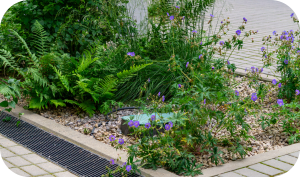
SuDS (Sustainable Drainage Systems) are replacing traditional urban pipe only systems and bring together water, landscape and people. But on many constrained development sites, the drive to make drainage hydraulically fail-safe is having the opposite effect: pushing designs towards large, sterile detention basins that function during an extreme storm event but offer little value on a day to day basis. If sustainable drainage is to live up to its name, do we need a more balanced way to judge what makes a “good” design?
This ambition is reflected in policy. In Wales, SuDS are mandatory for new developments under Schedule 3 of the Flood and Water Management Act 2010 and are supported by statutory standards. In England, Schedule 3 has not yet been implemented, but SuDS are widely required through planning and updated national standards were published in 2025.
When Good Intentions Become Hard Engineering
The challenge is that the hydraulic design standards for SuDS can be more demanding than those commonly used for traditional sewered drainage. It is often expected that surface water runoff for the 1 in 100 year event should be retained on site, plus an allowance for climate change and freeboard. By comparison, adoptable surface water sewer networks are typically designed so that the system does not flood in a 1 in 30 year storm. When applied rigidly, SuDS can be asked to hold far more water than a conventional piped system would have been designed around.
The discharge rate tightens the constraint further. Designers often need to restrict runoff to the greenfield equivalent rate – the rate at which water would have left the site before development. In some counties, even the 1 in 100 year event must be limited to the 1 in 2 year greenfield runoff rate. This is understandable from a downstream flood risk perspective, but it further increases the volume that must be kept on site.
Conservative Assumptions Can Compound The Issue
The Wallingford Procedure was published in 1981 introducing the modified rational method for the design and analysis of urban drainage. Today, this still underpins the methodology for sizing sewer dimensions so assumptions built into the procedure matter when they are applied to modern SuDS design. In particular, the assumption on the amount of rainfall that becomes runoff. The runoff is modified by a coefficient, C, that is a volumetric runoff coefficient, Cv, multiplied by a routing coefficient, Cr. For the former, common default values in industry software such as MicroDrainage and Causeway Flow are 0.75 in summer and 0.84 in winter, recognising that some rainfall is lost to surface wetting, minor ponding, cracks, edges and adjacent permeable areas. Whilst for the latter, a fixed value of 1.3 is recommended for design. However, some approving bodies ask for Cv to be set to 1.0. When used to size the sewers, in combination with the routing coefficient, this increases calculated flows by up to 30%. During a simulation, the volumetric runoff coefficient alone is used so setting this to 1.0 will assume that every drop of rain falling on drained surfaces reaches the drainage system.
Other assumptions and design standards can push attenuation volume in the same direction: adding urban creep to allow for future extensions and paving, removing initial storage allowances, and requiring attenuation systems to half-drain within 24 hours even where allowable discharge rates are low. Each adjustment is understandable in isolation but together, they can create a design that is highly conservative.
The Unintended Result: Bigger Basins, Fewer Benefits
For high density developments, the design standards alongside a tendency to adopt a conservative approach to design, dictates the SuDS scheme. Instead of a network of smaller, softer features routed through the site, the storage requirement can become so large that the design is driven towards a single end-of-pipe solution. The result is often a large detention basin that is functional but that is engineered, fenced off, steep-sided, visually sterile, and normally empty.
Where infiltration is viable, some of this pressure can be relieved, but this opportunity is often limited or unviable due to ground conditions, groundwater, contamination or clay shrink-swell risk. Other SuDS like green roofs, rain gardens, swales and permeable paving can all contribute, but if SuDS are not integrated into the development ethos from its conceptualisation, these will typically have a minor impact and not shape the drainage strategy. In trying to make SuDS hydraulically robust, there is a risk of losing the qualities that make them sustainable.
Towards a More Balanced Standard
This is not an argument for weaker drainage design, but one for better-balanced design. SuDS still need to manage flood risk, but if every assumption is set to be conservative, the outcome can be drainage that is technically compliant but less sustainable in practice. A more flexible, risk-based approach could place equal value on source control, everyday rainfall interception, safe exceedance routes, water quality, amenity and biodiversity — alongside hydraulic performance. This would reduce the tendency for designers to dismiss other SuDS features such as rain gardens, green roofs and rainwater harvesting as not providing sufficient storage. If SuDS are to deliver, designers, approving bodies and developers need to ask “what drainage approach will create the safest, most resilient and most valuable place?”. The goal should not be to implement the biggest basin that can be justified, but the best drainage system for the place it serves.