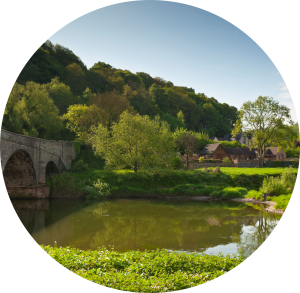
The River Wye is one of the longest rivers in the UK. It stretches 215 km from Mid-Wales to the Severn Estuary. The river and its catchment contain several nationally rare flora and fauna; crayfish, lamprey, salmon and otter live in the river, and rare native woodland and quaking bog ecosystems are present on its banks. Consequently, the Wye and its main tributary, the Lugg, are designated as a Special Area of Conservation (SAC) and Site of Special Scientific Interest (SSSI). The Wye Valley is also designated as an Area of Natural Beauty (AoNB), underlining its importance for tourism.
In May 2023 Natural England downgraded the status of the river from ‘unfavourable-improving’ to ‘unfavourable-declining’. This downgrade serves as a formal acknowledgement of the sad reality that has befallen the watercourse; a river increasingly choked by thick algal blooms. Excess phosphorus (or phosphate – a dissolved form of phosphorus, readily available to plants) is the primary concern which Natural England have highlighted to be fundamental to the current poor condition of the river.1
Phosphate is commonly associated with poor conditions in rivers because it is often the main cause of eutrophication. Eutrophication is when there is an excess of nutrients in rivers, causing excessive growth of algae (otherwise known as an algal bloom). Phosphate is often the limiting nutrient in freshwater ecosystems, meaning that under normal conditions, its scarcity keeps algal growths in check. However, once an excess of phosphate enters the watercourse, algae can multiply without restriction. Algal blooms typically occur when the conditions in the river are favourable for the algae – warm temperatures, slow river flows, lots of sunlight and excess nutrients. The blooms create a blanket on the water surface, blocking out the sunlight from plants on the riverbed and inhibiting photosynthesis. Once the algae die, the bacteria that decompose the algae take up oxygen in the water column.
In the River Wye, mild algal blooms have always been present, only recently have the blooms seemingly increased in length and severity. Prior to 2010, blooms would typically start 73 miles upstream of the tidal zone. The 2020 bloom almost doubled this distance, starting 144 miles upstream of the tidal zone. As algae can multiply every 24–48 hours, this migration upstream of the ‘starting point’ gives the bloom more time to accumulate mass as it travels downstream, resulting in a significantly greater environmental impact. The migration of the blooms’ starting point has been attributed largely to the increase in phosphate in the upper reaches of the Wye in Wales, where a large expansion of the poultry industry has taken place since 2008. The upper Wye catchment now hosts an extra ten million chickens, with the Wye catchment currently hosting a quarter of the UK’s total farmed poultry. Chicken manure is rich in phosphate and therefore its increased production and inadequate control measures are likely to lead to an increase of phosphate in rivers.
Agriculture is the major land use within the Wye catchment. Research by RePhoKUs2 highlights that the catchment imports a total of 6,500 tonnes of phosphate a year as feed and fertiliser, while only 3,100 tonnes are exported. Source modelling by the Environment Agency suggests that rural land use contributes 72-74% of the total daily phosphate in the rivers, while sewage treatment works contribute 21-23%. Furthermore, the soils in the catchment are sandy and silty, which increases the catchments vulnerability to phosphorus leaching when fertiliser is applied to the soils. Sandy soil is less able to retain and attenuate pollutants than clayey soils, for example. So in the Wye catchment, phosphate is more readily released into the water environment compared to many other soil types. Additionally, a lack of iron and aluminium in the Wye soils means that they have a low capacity to retain phosphate, which would otherwise occur through adsorption with iron and aluminium oxides or chemical reaction. A lack of retention and low storage capacity combined, mean that there is a high risk of phosphates draining into streams, thereby promoting algal blooms and eutrophication in the River Wye.
Due to the legacy of phosphates already in the system, a net reduction of imports is required to eliminate the phosphates and achieve a return to sustainable loads. The RePhoKUs project highlights that to reduce the catchment’s phosphate balance to net zero, fertiliser imports would need to be reduced by 75% and at the same time 80% of all pig and poultry manure would need to be exported out of the catchment.
While the spotlight remains on phosphates as the main driver of the River Wye’s recent increase in algal blooms, it’s unlikely to be solely responsible. As previously mentioned, mild blooms have been present in the River Wye prior to 2020 and elevated phosphate concentrations have been a fixture of the catchment for 150 years. This suggests that other factors are involved in causing the recent increase algal blooms, where phosphates are only one piece of the puzzle.
In response to the blooms in 2020, Citizen Scientists have been testing the River Wye, with over 400 active Citizen Scientists gathering water quality data (as of July 2024). This work is complemented by the UK government’s pledge to fund research into the declining condition of the River Wye. Alongside these scientific endeavours, non-profit organisations have been taking legal action. A 2024 case against the Environment Agency for failing to enforce farming regulations was dismissed, however, in October 2025 a class action lawsuit was filed against Welsh Water, Freemans of Newent Ltd and Avara Foods Ltd. This is currently ongoing and claims the defendants have caused pollution of the River Wye. The defendants all currently deny the claims.
In summary, the River Wye is suffering from severe eutrophication, with excess phosphate from agricultural and sewage treatment works being implicated. The arrival of high intensity phosphate producers, to the upstream reaches of the watercourse, is likely extending the life and severity of the algal blooms that arise, causing severe adverse effects to the river ecosystem. We look forward to presenting further research into the catchment and associated water quality issues with the River Wye, as they develop.